The Neighborhood That Broke the CAD
Somewhere in the dark heart of municipal planning, a developer sat down with a thesaurus, a phonics workbook, and a profound contempt for the dispatchers of the future. This is their neighborhood.
Every dispatcher has a "wait, can you spell that?" street. The one where you've worked the same console for eleven years and you still ask. Sequim. La Jolla. Puyallup. The names that sound like one thing and look like another. Fine. We adapt. We learn. We make the phonetic notes in the back of our brains and we move on.
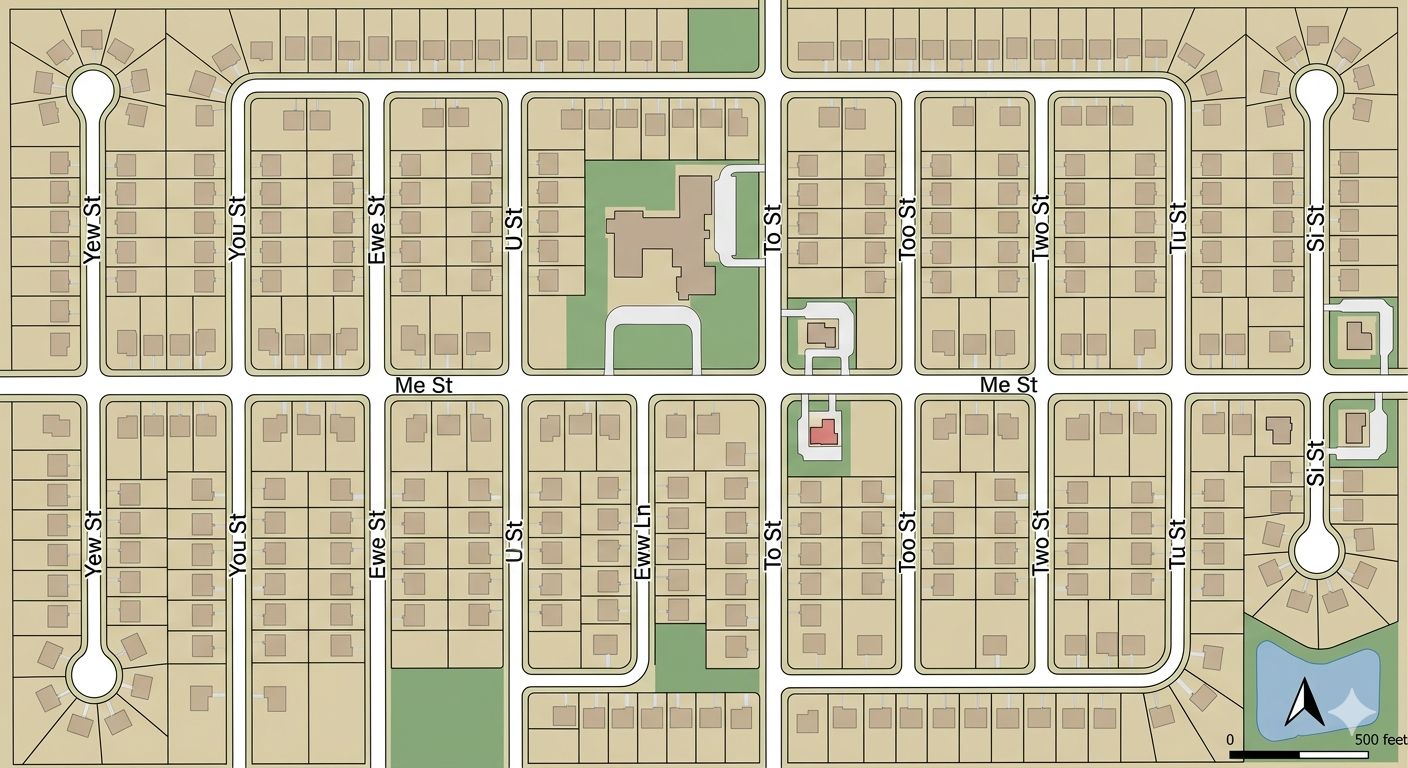
But somewhere out there — and I will not say where, because I refuse to be responsible for the pilgrimage — there is allegedly a neighborhood where every street name is a homophone of every other street name. And they all intersect. And one of them is named Me Street.
Picture the call.
The Roster
Per the (entirely apocryphal, definitely cursed) plat map, the neighborhood includes:
- Yew Street — the tree. The actual word a normal person might spell.
- You Street — second-person singular pronoun. Possibly named for narcissism.
- Ewe Street — a female sheep. Spelled like a typo of Europe.
- U Street — already a real street in DC, which is no excuse.
- Eww Street — the expression of disgust, weaponized as wayfinding. Pronounced exactly like Ewe. Genuinely on a sign somewhere.
- To Street — preposition. One letter from a number.
- Too Street — also, additionally. Adds a letter, somehow worse.
- Two Street — the word, not the number. Sounds like To. Sounds like Too. Sounds like Tu. Sounds like the entire problem.
- Tu Street — Spanish "you," informal.
- Si Street — Spanish "yes." Or English "see." Or the chemical symbol for silicon. Pick a struggle.
- Me Street — the road they all cross. Center of the universe. Apparently.
So a caller can plausibly be at You and Me, Ewe and Me, Eww and Me, U and Me, Yew and Me, Tu and Me, To and Me, Too and Me, or Two and Me, and they will all sound exactly the same on a 30-second VoIP call from a guy who has just sliced his hand open with a box cutter and is, understandably, not in the mood to spell.
"Ma'am, when you say 'meet me at you and me,' do you mean the intersection, or are you proposing?"
The Operational Nightmares
1. The phonetic alphabet stops working
"Yankee, Echo, Whiskey" and "Yankee, Oscar, Uniform" both arrive at a CT's brain as "some Y word." By the time you've gotten to the second letter, the caller has hung up to apply pressure to the wound.
2. ProQA cannot save you
Determinant codes assume a verifiable address. The protocol does not have a card for "the caller said 'me' and burst into tears."
3. AVL routing for units
You give the unit "respond to Yew and Me." They acknowledge. They drive to Ewe. They are now four blocks away, looking at a sheep-themed cul-de-sac, while the patient bleeds out at the correct intersection.
4. The radio traffic
5. The call review the next morning
The QA supervisor pulls the audio. They listen. They listen again. They put their headphones down. They walk to HR and request retirement paperwork.
No municipality has ever actually approved this entire street layout. But every single one of these names exists somewhere. Somewhere in America there is a real Ewe Lane and a real Yew Court and a real You Street and a real Me Avenue, and the only thing standing between us and total geocode collapse is the merciful fact that they live in different ZIP codes.
For now.
Filed from a console somewhere in the Pacific Northwest, where at least our weird street names are just unpronounceable, not phonetically identical. Yet.